

The Dark Forest or Mars?
Preparing Children for the Future


I recently returned from Astronomy Camp, a seven-day immersion in stars, galaxies, nebulas, mind-challenging conceptions of time and space and conversations not typical at your usual dinner party.
The days were warm and ripe for reading, swimming, hikes and naps. Nights began in an open field with cows grazing placidly beside us. Galaxy viewing rigs were scattered like aliens across the meadow. And as light melted into dark sky, meteors drew gasps, and the vivid presence of the Milky Way brought me back to the actual meaning of the word AWESOME.
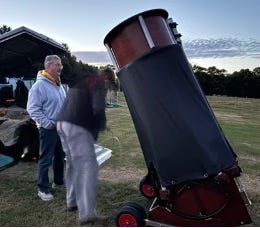
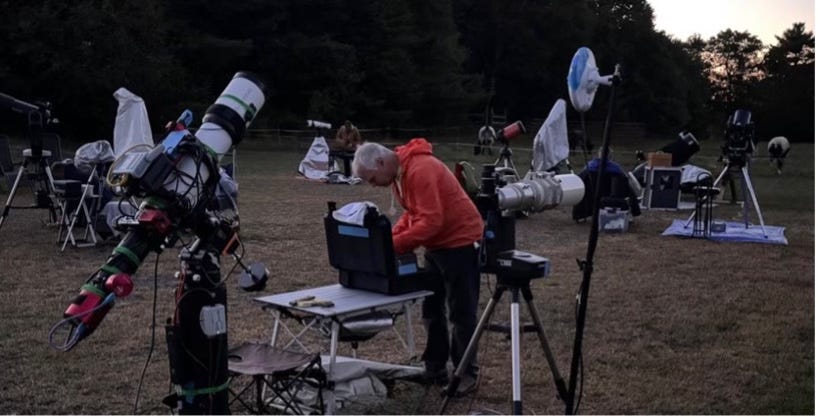
A novice in a community of astronomers, astronauts and cosmic experts, I’d anticipated discussions about sci-fi writers and speculative fiction. But the first time I asked a fellow ‘camper’ about Neal Stevenson’s novel, Seveneves, his response was, “I’ve always been drawn more to real science than sci-fi.” I got the message. I needed to be respectful of the seriousness these folks brought to the retreat.
The Dark Forest
But towards the end of the week, still curious about what people thought of science fiction that has inspired exploration of the skies over the ages, I asked another astronomer what he thought about Cixin Liu’s The Three Body Problem, a provocative exploration of what happens when a signal is sent into space and picked up by an alien civilization facing destruction. “The Dark Forest?” His face lit up in recognition. The Dark Forestis the sequel to the Three Body Problem. It explores humanity’s existential response to being ‘discovered’ by aliens. It became clear quickly we both love the puzzle of how/what humanity’s response to such an event will be.
I say WILL because the math is hard to dispute. Astronomers tend to think the question is when not if. The existence of two to twenty trillion galaxies makes the possibility of SOME other civilization out there not just plausible, but likely. They (or we) may not make contact for millennia, but we COULD get a signal tomorrow. Possibly ET is calling now—or picking up a probe NASA (or China) sent years ago.
Whether making ourselves known with our various probes and rockets is an inherent threat to humankind, or, as many believe, the way humankind ultimately protects itself, is an existential question. Are you a ‘Dark Forest’ advocate (keep your head down) or a ‘head to galaxies far, far away’ fan? Cixin Liu’s speculative fiction provokes this question.
I confess when I signed up for the retreat, had that been an ‘admissions question’, I would likely have come down as a Dark Forest fan. But I’m also a Thomas Friedman fan and one of his most important observations is that “technology is accelerating faster than our ability as humans to adapt. “Technology,” he reminds us, “is evolving at exponential rates of change; human evolution is infinitely slower to adapt to change.” What we can DO (build AI for example) appears to be far easier than what we can MANAGE (figure out how to keep AI from destroying us).
A daily review of the news—whether you follow the NYT or TikTok--makes this hard to dispute. Primal rage, greed, the slow response to climate urgency, the prevalence of zero-sum thinking in everyday life, is not a reassuring picture of humanity’s capacity to rise above our most primitive instincts to engage with an advanced civilization. To hope AI will do better than humans, is to my mind, resignation itself.
Kids and the Future
What does this ramble have to do with preparing kids for the future? It’s time to reimagine adaptability and innovation in the family. Early adopter families are doing this now. People who push for innovation in their businesses are seeing the need to do the same at home—and kids are often leaders in this effort. Fluid, still in learning states, exploratory, they’re ready to be the tip of an innovation force in family.
The die is cast. Rockets, people, space ventures and space speculators are probing deep space. Whether or not my own inclination is to stay hidden in the ‘Dark Forest,’ today’s six-year-old (and those kids not yet conceived) will be managing a very different world from the one we wrestle with today. It’s absurd to think we know what that will look like. But it is not absurd to nurture skills required to engage with any group capable of redirecting primal behaviors (hate, fear, envy, greed, etc.) into more sophisticated—and effective—tools for engagement.
One can argue we’ve done the reverse. By immersing children in digital worlds (and providing AI ‘friends’), influencers, and virtual realities we deprive them of the practice needed to develop the more elevated skills of critical thinking, relationship-building, agency, creativity, and adaptability; skills that focus on higher level thinking.
Astronaut, Capt. Tom Jones was one of the most engaging speakers at Astronomy Camp. His photos from space (and his space walks) were dazzling. And I appreciated his ability to make space science accessible for this layperson.
But what got my attention was his emotional intelligence. Persistence and resilience are among his core qualities and his command of himself—and awareness of others—was palpable. Caught in a space emergency with Capt. Jones or someone with less sophisticated human skills, I want to be on the Jones’ flight. More than intellect and space knowledge, Jones possess advanced EQ. His persistence in the face of defeat and disappointment is Herculean, clearly a superpower. He applied to be a NASA astronaut four times from the mid-1980s to 1990 before being accepted as an astronaut. Then he still had to go through the process of becoming rocket ready. “No” is catnip to this guy.
How do we help kids persist, to keep their cool in unexpected circumstances, to ‘think’ their way out of a dilemma (rather than bully or have someone else problem solve for them)? What can we do to coach and nurture 21st and 22nd century skills? How can we aid the evolution of children’s adaptability and ready them for futures we can barely imagine?
My astronomy camp colleagues appear to be on the optimistic side of the Dark Forest question. They believe that space exploration requires us to solve technological problems that will keep us safe. They’re confident that solving mega-challenges (like how to survive on a hostile planet—Mars for example) will have multiple rewards for humankind here on the ground. I’m not advocating we prepare kids to become astronauts. Or move to Mars. What I came away from astronomy camp with is a deep appreciation for what it will take to prepare kids for the very real near future barreling at them—whether or not ET is set to visit.
Edwin Land, inventor of instant photography, steadfastly believed his life’s mission was to focus on problems"manifestly important and nearly impossible.” What can we do to encourage kids to take on challenges that are manifestly important and nearly impossible?
How can we support children’s evolution away from the ‘fear based, scarcity oriented, zero-sum games’ culture so prevalent today? How can we prepare kids for galaxies far, far away—or at a minimum, encourage the development of emotional intelligence that makes life on THIS planet a little better in the not-so-distant future?
Let’s talk!
Joline - it was great to meet you at Medomak. An engaging conversationalist on matters other than image pixels, etc. And the talks and a wide-range of guests are what help to make the week so great there. On the matter of ‘Extraterrestrial’ my Princeton Astronomy club had an excellent speaker talking on that very subject this month . Dr Edwin L. Turner’s (of Princeton - a bona fide Expert)
talk “An Observable Universe Devoid of Extraterrestrial Life, Intelligence, and Technological Civilizations Is Plausible” was eye-opening and, as he opened with, a bit disheartening. The title pretty much sums up his conclusions! Still, adds to the debate.